COSY vs TOCSY: Understanding the Key Differences and How to Interpret the Spectra
For structural analysis of complex organic molecules and natural products, 2D homonuclear scalar-correlation NMR experiments are among the most useful tools for resolving ambiguities caused by overlapping signals in 1D spectra.
Among the most widely used 1H-1H correlation experiments, COSY and TOCSY answer two different but complementary questions.
COSY is mainly used to trace local proton-to-proton connectivity through observable J couplings, while TOCSY extends magnetization transfer through a continuous coupling network and helps identify all observable members of the same spin system.
In practical terms, COSY helps answer "Which protons are coupled to each other?", while TOCSY helps answer "Which protons belong to the same spin system?"
This article walks through the two experiments from pulse-sequence principles to practical spectrum interpretation, explaining their key differences and how they can be used together in 2D NMR spectroscopy.
COSY, or Correlation Spectroscopy, and TOCSY, or Total Correlation Spectroscopy, both use scalar coupling, or J coupling, to provide proton correlation information through chemical bonds.
However, the type of structural information they are designed to reveal is different.
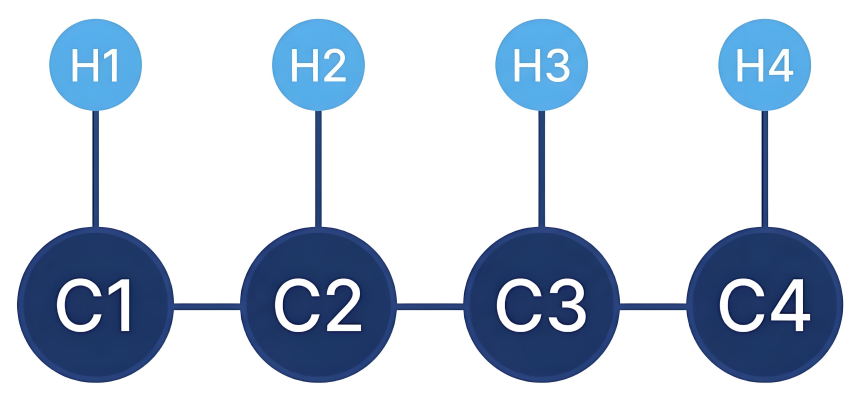
Consider a continuously coupled proton chain:
H1 → H2 → H3 → H4

COSY primarily detects directly observable scalar couplings between pairs of protons.
The most common correlations arise from 2JHH and 3JHH couplings, for example:
H1 ↔ H2
H2 ↔ H3
H3 ↔ H4
These pairwise correlations allow researchers to build the local proton connectivity step by step.
In other words, a COSY spectrum is particularly useful when the goal is to reconstruct the sequential relationship between neighboring or otherwise detectably coupled protons.
Note: COSY correlations are not restricted to two-bond and three-bond couplings. In allylic systems, aromatic systems, or rigid W-type geometries, a sufficiently strong 4J coupling, typically greater than about 1.5 Hz, may also generate a COSY cross peak. Therefore, the presence of a cross peak alone should not be taken as proof that two nuclei are directly adjacent in the molecular structure.
TOCSY takes a different approach.
Through magnetization transfer across a J-coupled network, protons within the same continuous spin system can become correlated even when two particular protons do not show a strong direct coupling to each other.
Its main purpose is therefore not to determine the direct connectivity of every proton pair. Instead, TOCSY is used to identify and group multiple protons that belong to the same spin system.

For example, if H1, H2, H3, and H4 form a continuous coupling network, magnetization can propagate through the sequence:
H1 → H2 → H3 → H4
As a result, correlations between more distant members of the system may appear in the TOCSY spectrum.
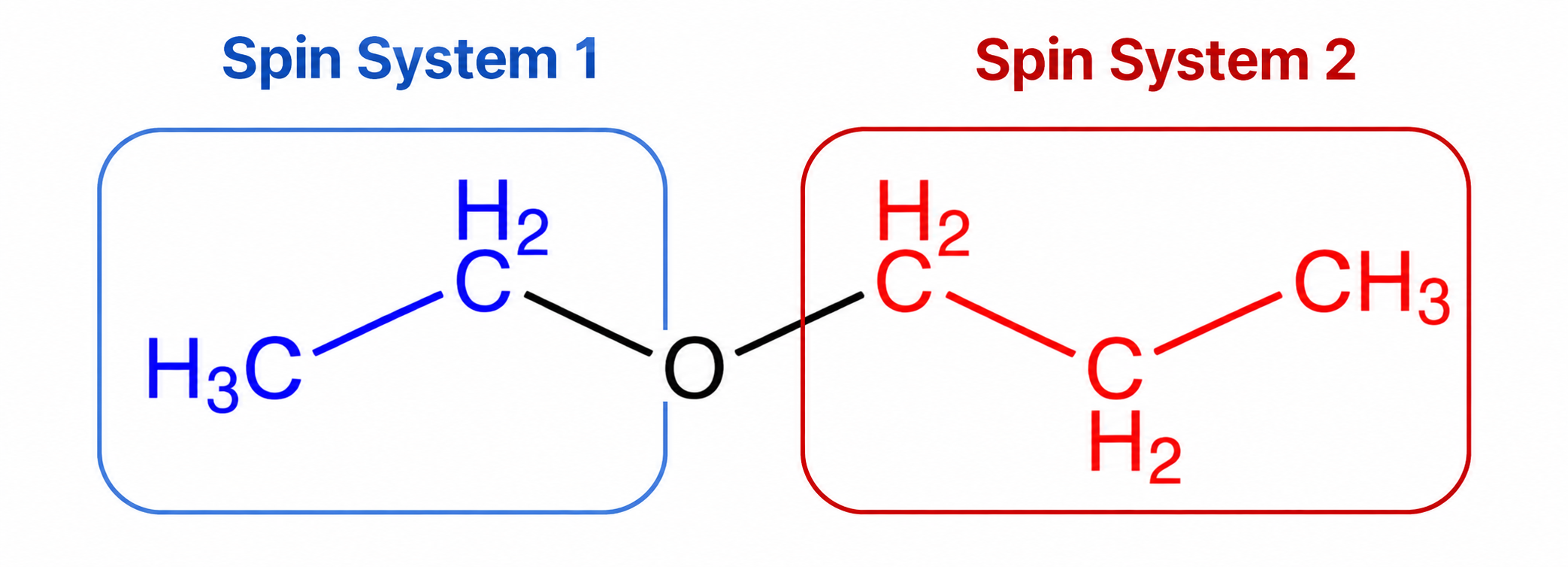
Note: A spin system usually consists of a group of nuclei connected by a continuous pathway of sufficiently strong J couplings. If the effective coupling between parts of a molecule becomes very weak or is absent, magnetization transfer may be interrupted. This can occur when groups are separated by a quaternary carbon, certain heteroatom arrangements, or geometries with a dihedral angle close to 90°, where the coupling becomes very small. The result is the formation of relatively independent spin systems.
The fundamental difference between COSY and TOCSY comes from the way magnetization transfer is handled after the indirect evolution period, t1.

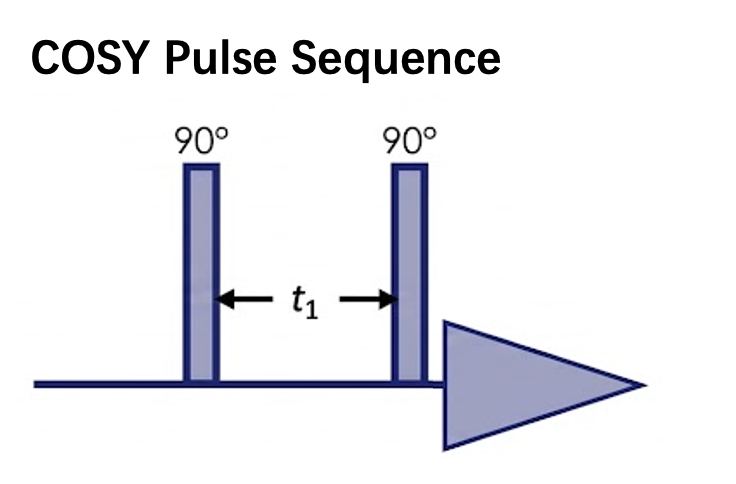
The basic COSY pulse sequence can be represented as:
90° - t1 - 90° - Acquisition (t2)
The first 90° pulse rotates the longitudinal magnetization into the transverse plane.
During the t1 evolution period, both chemical shift and J coupling contribute to the evolution of coherence.
The second 90° pulse then produces direct coherence transfer.
Coherence that remains on the original nucleus contributes to the diagonal signal during the t2 acquisition period, while coherence transferred to a coupled nucleus generates a cross peak.
Conventional COSY therefore mainly records pairwise direct J-coupling relationships.
In the spectrum, these correlations commonly represent neighboring protons or geminal protons attached to the same carbon.

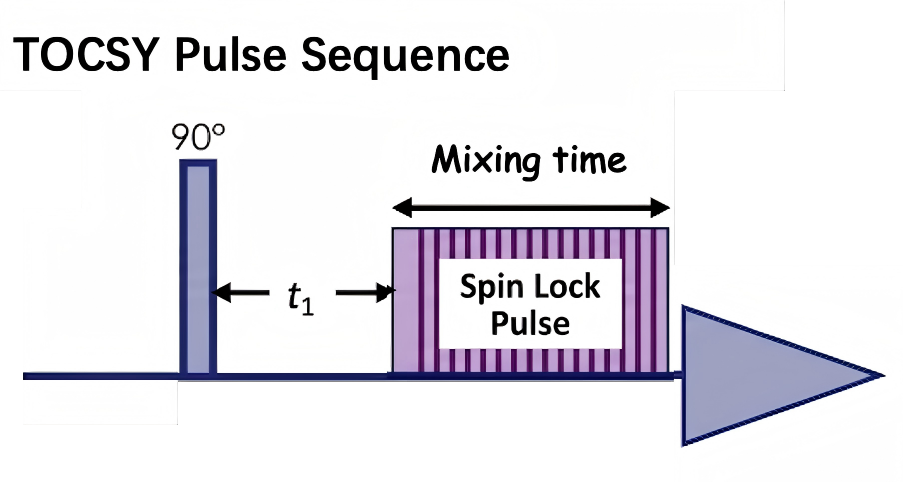
TOCSY introduces an additional spin-lock mixing period after the t1 evolution period.
The spin lock is not simply one long RF pulse. It is usually implemented using composite pulse trains such as MLEV-17 or DIPSI-2.
During the mixing time, these composite pulses generate isotropic mixing, allowing magnetization to propagate through a continuous J-coupling network.
Magnetization first transfers between directly coupled neighboring protons and can then continue stepwise through the system:
H1 → H2 → H3 → H4
This relay mechanism allows TOCSY to correlate more distant members of the same spin system.
The duration of the spin-lock period is referred to as the mixing time, and it is one of the most important parameters controlling the depth of magnetization transfer in TOCSY.
Short mixing time, for example 20 to 30 ms
Magnetization transfer has only just begun. Correlations are dominated by nearby coupled protons, so the resulting spectrum may resemble a COSY spectrum.
Moderately long mixing time, for example 60 to 100 ms
This is a commonly useful range for many small molecules and natural products. Magnetization has more time to propagate through a continuous spin system, allowing more distant members to become correlated.
Longer mixing times
Longer is not always better.
Increasing the mixing time may allow magnetization to reach more distant parts of the coupling network, but relaxation and RF-related effects also become increasingly important.
T2 relaxation can reduce signal intensity, while RF heating and other experimental effects may contribute to signal loss or line broadening. Under some pulse-sequence and experimental conditions, longer mixing periods may also increase unwanted relaxation effects or pulse-related artifacts.
For this reason, the optimum TOCSY mixing time should be selected according to molecular size, coupling topology, relaxation behavior, and the spin system of interest.
In a 2D 1H-1H spectrum, both axes represent proton chemical shifts.
Signals along the diagonal correspond to resonances observed in the conventional 1D 1H NMR spectrum.
Cross peaks located away from the diagonal indicate that magnetization has been transferred between two proton resonances through scalar coupling pathways.
Depending on the experiment, these correlations can represent either direct pairwise couplings or connectivity within a continuous spin system.
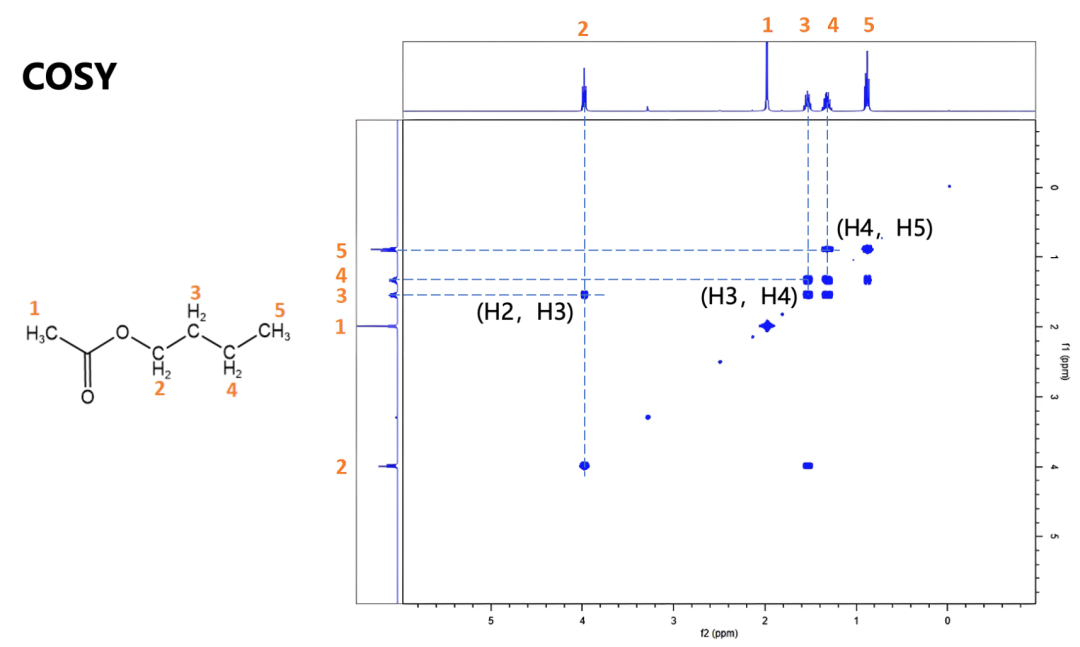
The following example uses n-butyl acetate to illustrate the practical interpretation of COSY and TOCSY spectra.

In n-butyl acetate, the carbonyl carbon has no attached proton.
There is also no observable continuous proton-coupling pathway between the acetyl methyl group and the n-butyl chain.
The n-butyl chain can therefore be analyzed using a stepwise tracing strategy.
By following these individual pairwise cross peaks, the local proton-connectivity sequence can be reconstructed step by step.
Importantly, there are no major H2 ↔ H4 or H2 ↔ H5 correlations in the COSY spectrum.
This illustrates one of the most important differences between COSY and TOCSY. COSY primarily reveals the observable pairwise coupling relationships required to build the local proton framework.

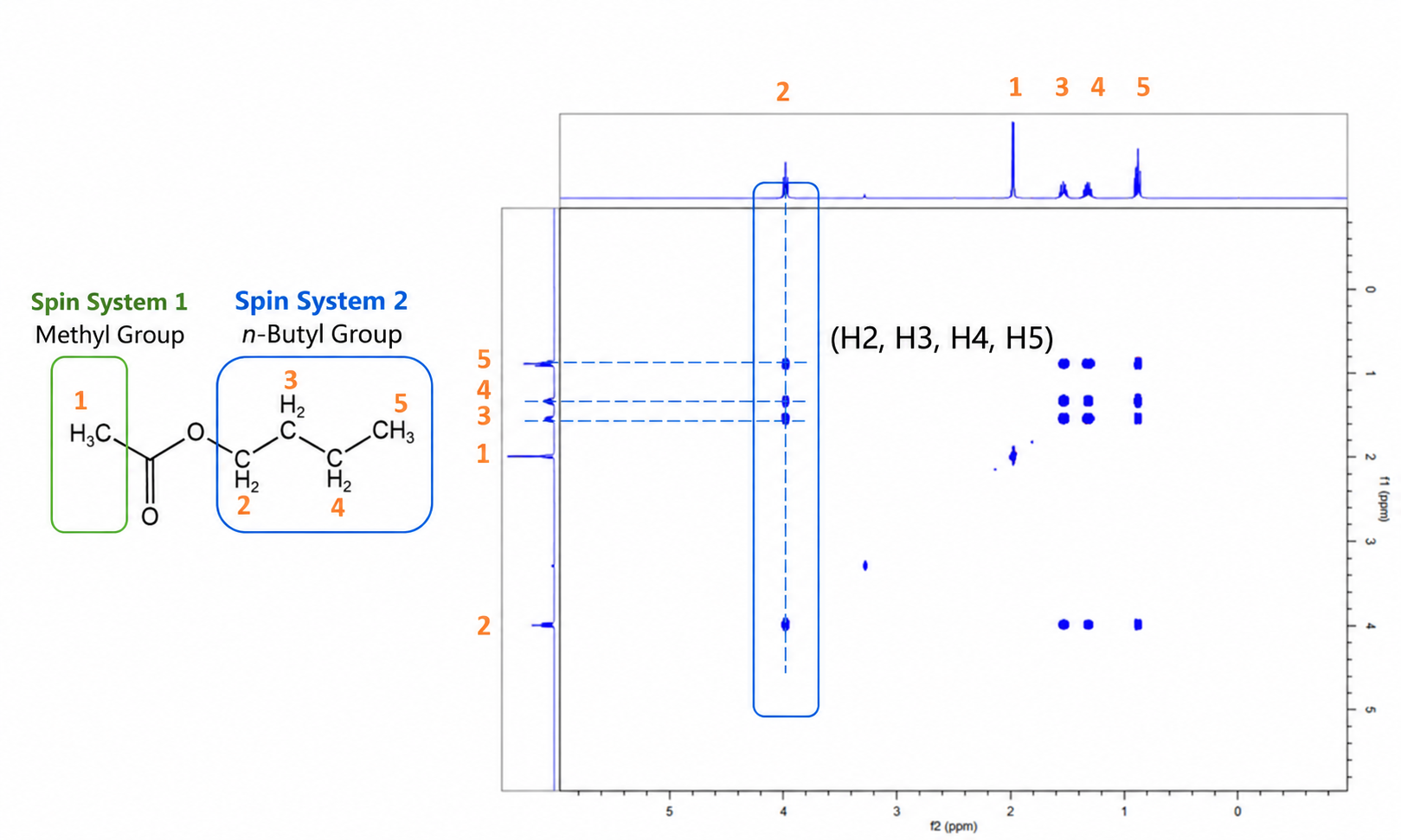
For a TOCSY spectrum acquired with an appropriate mixing time, a different interpretation strategy can be used.
These signals can therefore be assigned to the same n-butyl spin system.
The absence of H1 from this trace indicates that the acetyl methyl group and the n-butyl protons belong to different spin systems under these conditions.
This approach becomes particularly useful for more complex molecules.
In peptides, for example, an amide NH or an α-H signal can be used as an anchor. In oligosaccharides, the anomeric proton H-1 is often a particularly useful anchor signal.
In these systems, many intermediate proton resonances may overlap within a narrow chemical-shift region. A stepwise COSY assignment can therefore become difficult or may be interrupted by severe spectral overlap. TOCSY can help bypass this problem by allowing correlations to extend across the coupled network, making it possible to classify signals into spin systems even when individual intermediate resonances are difficult to distinguish.
| Comparison | COSY | TOCSY |
|---|---|---|
| Core information | Observable J coupling between pairs of protons | Observable correlations among members of the same spin system |
| Main purpose | Build local proton connectivity step by step | Identify and group complete spin systems |
| Pulse-sequence feature | Two 90° pulses in the basic sequence | Adds a spin-lock mixing module after evolution |
| Magnetization transfer | Mainly pairwise coherence transfer | Stepwise relay through isotropic mixing |
| Meaning of cross peaks | Pairwise scalar coupling, commonly 2J to 4J and especially 3J | Indicates that two nuclei belong to the same connected spin system |
| Typical applications | Small-molecule drugs and synthetic compounds, particularly for establishing local carbon-skeleton connectivity | Carbohydrates, peptides, fatty-acid chains, and complex natural products |
COSY and TOCSY are therefore not competing experiments.
They provide different layers of structural information and are often most useful when interpreted together.
No.
For conventional small molecules, 60 to 100 ms is often a reasonable range to begin testing.
For more complex samples, it can be useful to acquire two datasets for comparison, for example a short mixing time of 20 to 30 ms and a relatively long mixing time of 80 to 100 ms.
With a short mixing period, the spectrum is dominated by correlations between nearby protons. A longer mixing period can reveal more distant correlations within the same spin system.
The optimum value, however, depends on several experimental factors, including J coupling, relaxation behavior, solvent, temperature, probe performance, and RF power. Mixing time should therefore be optimized for the specific sample and experimental objective rather than simply maximized.
No.
The absence of a visible cross peak does not necessarily mean that two nuclei are unrelated.
For example, according to the Karplus relationship, certain dihedral angles can significantly reduce 3J coupling.
A cross peak may also be difficult to observe if it lies close to the diagonal and is obscured by diagonal tails.
Exchangeable protons may undergo rapid chemical exchange, resulting in significant line broadening.
In TOCSY, a mixing time that is too short may also prevent magnetization from reaching more distant members of the spin system.
Therefore, a conclusion of "no coupling" should not be based on a missing cross peak alone. The interpretation should also consider 1D splitting patterns, complementary 2D NMR data, and the acquisition parameters used for the experiment.
Pulsed field gradients, or PFGs, can be used to select specific coherence-transfer pathways and suppress some t1 noise and artifacts.
Compared with certain conventional phase-cycled experiments, gradient-enhanced sequences may also reduce the number of scans required.
The actual amount of instrument time saved depends on the particular pulse sequence and acquisition parameters.
Gradient selection, however, cannot compensate for fundamental experimental problems. Poor shimming, inaccurate pulse calibration, inadequate solvent suppression, or insufficient sampling in the indirect dimension can still compromise spectral quality. Good basic experimental setup remains essential for obtaining reliable COSY and TOCSY spectra.
COSY and TOCSY form one of the most useful combinations in 2D NMR spectroscopy.
COSY helps establish which protons show direct observable J-coupling relationships, making it particularly useful for tracing local connectivity.
TOCSY helps determine which protons belong to the same spin system, allowing researchers to group related resonances even when individual intermediate peaks overlap or distant protons do not show a strong direct correlation.
The key is to define the structural question before selecting the experiment.
If the goal is to trace a local proton sequence, COSY is often the natural starting point. If the goal is to identify the members of an entire coupled spin system, TOCSY can provide the additional information needed.
High-quality NMR spectra are the foundation of reliable structural analysis. CIQTEK CAN Series liquid-state NMR spectrometers combine a stable magnet system with a comprehensive pulse-sequence library, supporting experiments from routine 1D NMR to a wide range of 2D NMR methods for research and teaching in chemistry, materials science, biomedicine, and related fields.

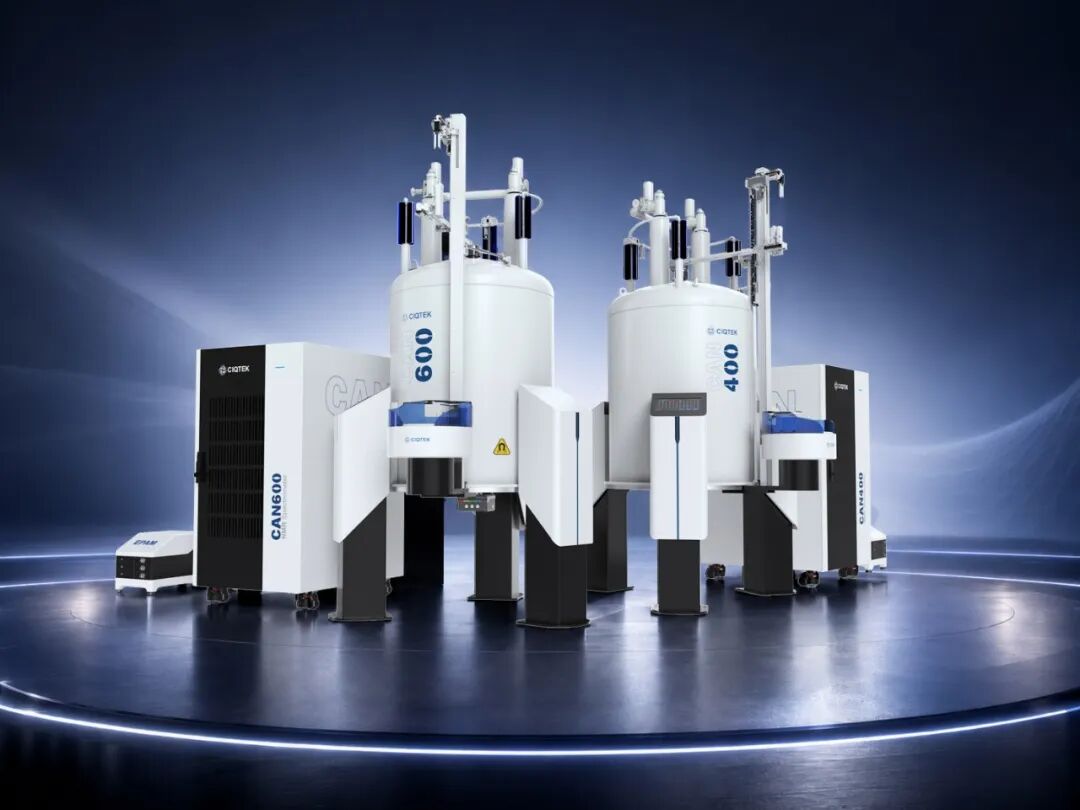
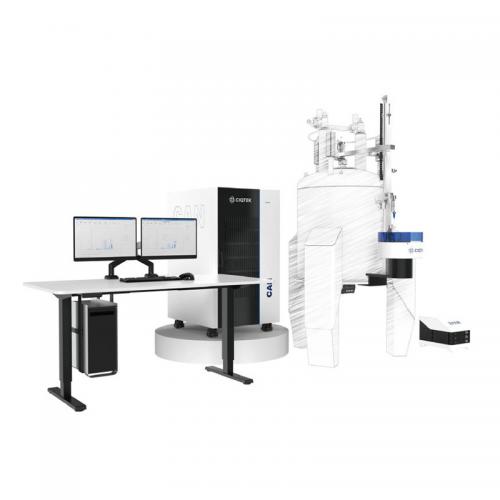
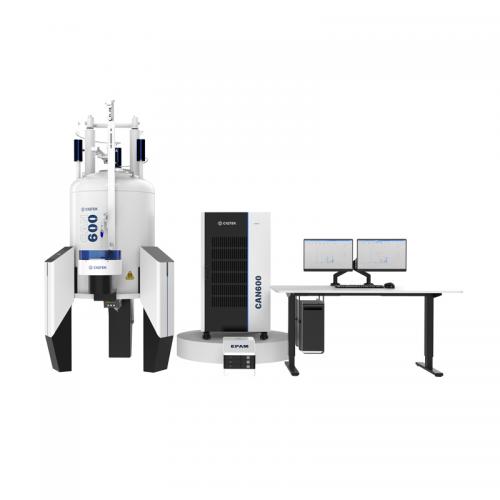
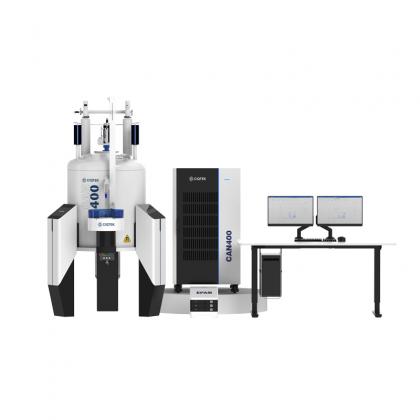
CIQTEK CAN400 and CAN600 liquid-state NMR spectrometers
When interpreting COSY or TOCSY spectra, the most difficult part is often not collecting more correlations, but understanding exactly what each cross peak does and does not tell you.
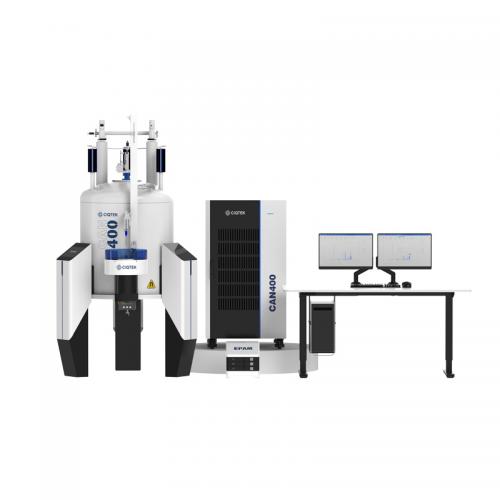
The CIQTEK CAN400 is an intelligent liquid-state nuclear magnetic resonance (NMR) spectrometer. The spectrometer system consists of a superconducting magnet with ultra-high homogeneity and ultra-shielding, a multifunctional intelligent console, and a high-sensitivity fully automated tuning probe, along with other modules. CAN400 can include multiple highly integrated RF transceivers. The improved design enhances the performance of tuning, shimming, and auto sample changing, reducing experimental time. Accessories such as the intelligent touchscreen expand the management interface of the NMR system. Sample insertion and ejection can be controlled and monitored via a touchscreen, elevating the flexibility of various experiments. CAN400 combines high-performance hardware and intelligent software, providing users with a more reliable and convenient NMR experimental platform.
Learn More
Compatible with 300-600 MHz Magnet The solutions involve retaining the magnet while upgrading other modules to the latest designs, aiming to enhance instrument performance, extend service life, improve automation efficiency, and obtain professional services in a more cost-effective manner.
Learn More
The CIQTEK CAN600 is a next-generation intelligent liquid-state nuclear magnetic resonance (NMR) spectrometer, featuring an ultra-shielded, ultra-homogeneous 600 MHz superconducting magnet, a modular integrated console, and high-sensitivity, fully automated tuning probes. The CAN600 features highly integrated transceiver RF channels, enabling multi-receiver experiments. Its novel design supports rapid tuning and shimming, significantly reducing the time required for experiment setup. Accessories such as the intelligent control touchscreen expand the system’s management, allowing users to monitor instrument status and control sample access directly via touch, enhancing the flexibility of NMR experiments. By combining high-performance hardware with intelligent software, CAN600 delivers a more reliable and user-friendly NMR platform for researchers.
Learn More
No. 1969, Kongquetai Road, High-tech Zone, Hefei, Anhui, China
+8615156059133
+8613083191369
info@ciqtek.com
Sitemap | XML | Blog | Privacy Policy | IPv6 network supported