CIQTEK Sponsored Young Scientist Award at the 12th Asia-Pacific EPR/ESR Symposium (APES 2022)
November 09, 2022
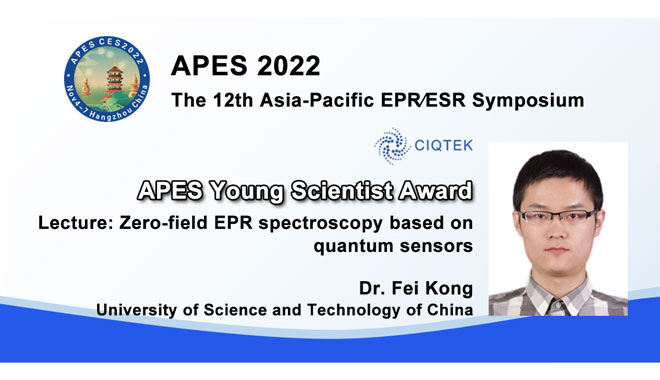
CIQTEK generously sponsored an annual lectureship and award, given to a young scientist who has made a great contribution to electron paramagnetic resonance (EPR or ESR) research. At the 12th Asia-Pacific EPR/ESR Symposium (APES 2022), the CIQTEK Sponsored Young Scientist Award was awarded to Dr. Fei Kong, CAS Key Laboratory of Microscale Magnetic Resonance and School of Physical Sciences, University of Science and Technology of China. As winner of the 2022 competition, Dr. Fei Kong was invited to gave a prize lecture at the conference, on November 6th.
APES 2022, Webinar, November 4-7, 2022
CIQTEK is happy to sponsor the APES 2022 during November 4-7, 2022. The symposium this year is an online event for international speakers and participants, a new start for Asia-Pacific EPR/ESR Society in the post-epidemic era. The main aims of APES 2022 are to bring together EPR/ESR spectroscopists and to promote and facilitate collaboration among the EPR/ESR community. APES 2022 is intended to stimulate discussions on the forefront of research in all aspects of EPR/ESR ranging from theoretical and experimental advances in CW/Pulsed EPR, high frequency, and high field EPR, ENDOR, PEDLOR/DEER, time-resolved EPR, FMR, MRI, ODMR to applications in medicine, biology, chemistry, materials science and nanotechnology.
Abstract of the Lecture: Zero-field EPR spectroscopy
The nitrogen-vacancy (NV) centers in diamond can promote the sensitivity of EPR detection to a single-spin level even under ambient conditions, and thus enable single-molecule EPR spectroscopy [Science. 347, 1135–1138 (2015); Nat. Methods 15, 697–699 (2018)]. A key figure of single-molecule EPR is that it can resolve heterogeneous molecular information, which is averaged in conventional EPR measurement. However, the current single-molecule measurements are insufficient to do so, due to the poor spectral resolution. Here, I will introduce an easy way to substantially improve the spectral resolution, i.e., removing the magnetic field. The zero-field EPR has been well-studied for decades [Chem. Rev. 83, 49–82 (1983)]. It has narrower spectra with the tradeoff of much poorer sensitivity. Difference from conventional inductive detection, the signal of NV-EPR comes from the statistical fluctuation rather than the thermal polarization of spins, which does not depend on the magnetic field. Therefore, the NV center is an ideal sensor for zero-field EPR detection. I will show that the NV-EPR has the advantage in not only spatial resolution but also spectral resolution.
Biography of Dr. Fei Kong
Dr. Fei Kong was born in Hefei, China. In 2012 he obtained a B.Sc. degree at the University of Science and Technology of China (USTC) and later undertook experimental research there on control and simulation using nitrogen-vacancy centers in diamond with Prof. Dr. Jiangfeng Du and Prof. Dr. Fazhan Shi. He received a Ph.D. degree based on this work in 2018. After 3 years of postdoctoral research on the single-molecule EPR in the same group, he is now a research fellow there. His research interest includes control and sensing, especially new EPR methods & techniques based on nitrogen-vacancy (NV) centers in diamonds. He has developed nanoscale zero-field EPR spectroscopy, which can greatly improve spectral resolution while maintaining single-spin sensitivity.
CIQTEK is pleased to continue supporting this award at future conferences to encourage more young scientists to contribute to EPR research.
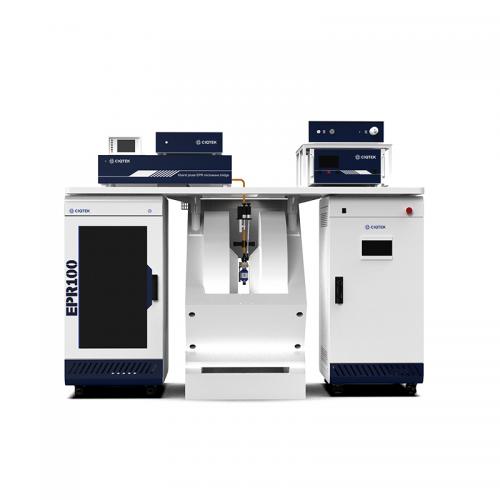
CIQTEK X-band pulse electron paramagnetic resonance (EPR or ESR) spectrometer EPR100 supports both continuous-wave EPR and pulse EPR functions. In addition to supporting conventional continuous-wave EPR experiments, the EPR100 can also finely control and measure electron spin quantum states using specific pulse sequences. This enables pulse EPR tests such as T1, T2, ESEEM (electron spin echo envelope modulation), HYSCORE (hyperfine sublevel correlation), etc. The EPR100 instrument offers a comprehensive range of optional accessories, such as ENDOR, DEER, TR-EPR, and AWG modules, which fully meet the requirements of all current pulsed EPR experimental modes. When paired with a variable temperature system, it enables the detection of paramagnetic substances at ultralow temperatures. Pulsed EPR spectroscopy provides higher spectral resolution, revealing the hyperfine interactions between electrons and nuclei and delivering more detailed structural information. This capability is irreplaceable and crucial in scientific research areas such as materials science, biomolecular structure analysis, etc.
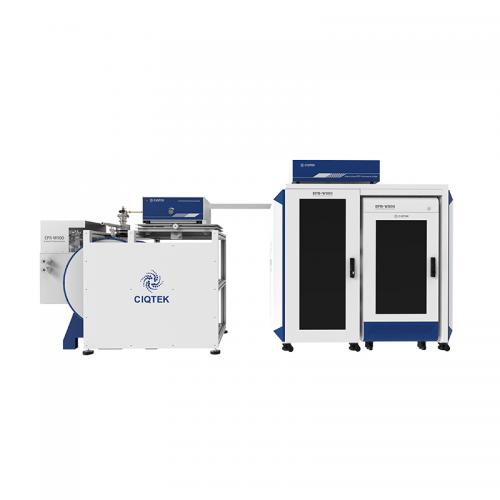
High-Frequency & High-Field Pulse Electron Paramagnetic Resonance (EPR) at W-Band (94 GHz) High-frequency EPR technology offers numerous advantages, such as high g-value resolution and minimal sample volume. It is highly applicable in biology, chemistry, and materials science. CIQTEK EPR-W900 supports both continuous-wave and pulsed EPR measurement, including ENDOR, and enables variable temperature experiments from 4 to 300 K. It is equipped with a split-pair superconducting magnet, with a maximum magnetic field of up to 6 T. The superconducting magnet, combined with a cryogen‐free cryogenic system, stabilizes the temperature in the superconducting region without consuming liquid helium, ensuring stable operation and easy maintenance. The EPR software platform is the same as the CIQTEK X-band pulsed spectrometer, making it simple and user-friendly.
X-Band Benchtop Electron Paramagnetic Resonance Spectrometer The CIQTEK EPR200M is a newly designed benchtop EPR spectrometer specializing in the qualitative and quantitative analysis of free radicals, transition metal ions, material doping and defects. It is an excellent research tool for real-time monitoring of chemical reactions, in-depth evaluation of material properties, and exploration of pollutant degradation mechanisms in environmental science. The EPR200M adopts a compact design and highly integrates the microwave source, magnetic field, probe, and main controller, ensuring sensitivity and stability while being compatible with diverse experimental needs. The user-friendly interface allows even first-time users to start quickly, making the EPR instrument truly easy to use. ★ Email our experts for custom solutions, quotes, or detailed brochures: info@ciqtek.com
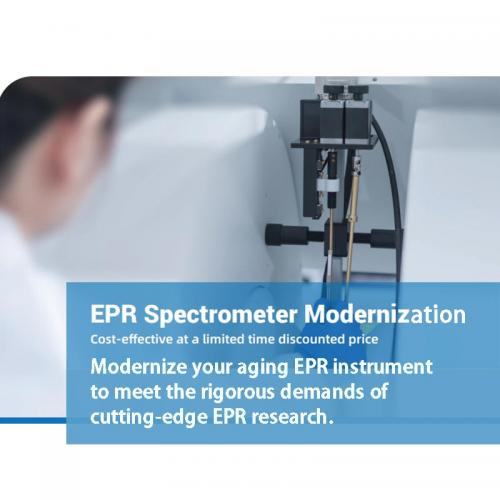
Modernize and upgrade your old EPR instrument for cutting-edge EPR research This Modernization service will bring you features including: ▶ Higher Sensitivity: Ultra-low noise microwave source and signal detection technology ▶ Better Resolution: Precise magnetic field control technology ▶ Excellent Compatibility: Compatible with a wide range of EPR spectrometers ▶ Fast Delivery: Complete delivery of the modernized hardware within 2-6 months ▶ High-quality Service: On-site installation and 2-year warranty ★ Email us for more details: info@ciqtek.com
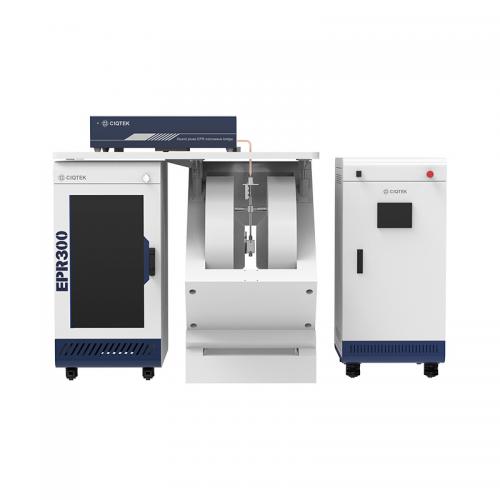
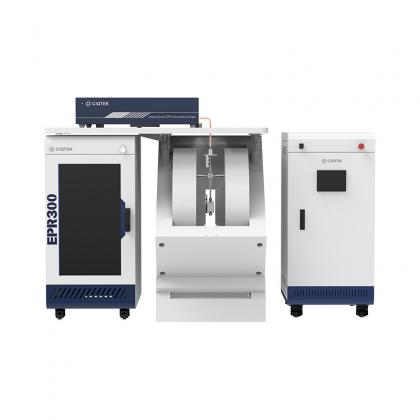
The CIQTEK EPR300 Electron Paramagnetic Resonance (EPR) Spectrometer incorporates the latest microwave technology and an ultra-high-performance signal processing unit, significantly enhancing detection sensitivity and signal-to-noise ratio to an unprecedented level. It enables precise detection and analysis of unpaired electron signals even at extremely low spin concentrations, providing a novel approach for exploring microscopic physical and chemical properties of low-concentration substances such as free radicals and metal ions. Additionally, the EPR300 supports easy upgrades from X Band to Q Band, achieving higher g-value resolution, which is advantageous for detecting anisotropic samples. The EPR300 establishes a solid experimental foundation for cutting-edge research in life sciences, materials science, chemistry, and physics, driving scientific discoveries to new milestones.
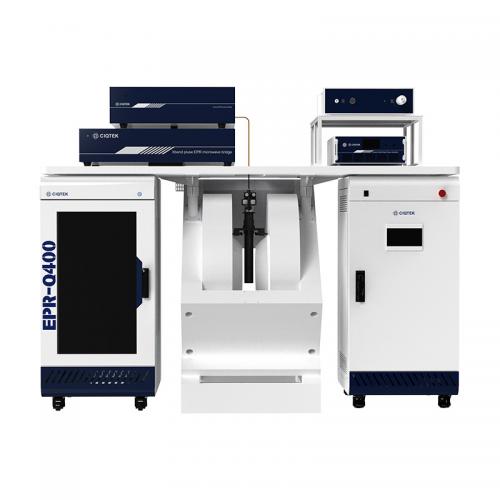
Compared with conventional X-band electron paramagnetic resonance (EPR), high-frequency EPR offers significant advantages and provides important capabilities across biological, chemical, and materials research. CIQTEK EPR-Q400 is a Q-band high-frequency pulse EPR spectrometer equipped with both continuous-wave (CW) and pulse EPR measurement modes (for CW-only experiments, the EPR-Q300 CW spectrometer is available). It supports variable-temperature experiments from 4 to 300 K. The EPR software platform is the same as the other CIQTEK X-band pulse spectrometers, making it simple and user-friendly.