
CIQTEK satisfies the needs of customers by providing customized products and complete application solutions in environmental science, biochemistry, lithium, chip semiconductors, and materials science to enable them to innovate and improve productivity.
CIQTEK SEM Microscopy Unveils Cu-C Nanospheres to Overcome Catalyst Deactivation in Wastewater Treatment
September 03, 2025
With the acceleration of industrialization and the continuous growth of pollutant emissions, organic wastewater poses a serious threat to ecosystems and human health. Statistics show that energy consumption from industrial wastewater treatment accounts for 28% of global water treatment energy use. However, conventional Fenton technology suffers from catalyst deactivation, leading to low treatment efficiency. Metal-based catalysts in advanced oxidation processes face common bottlenecks: the redox cycling process cannot be effectively sustained, electron transfer pathways are restricted, and traditional preparation methods rely on high temperature and high pressure with yields of only 11–15%.
To address these challenges, a research team from Dalian University of Technology developed a Cu-C nanocatalyst by directionally coupling commercial cellulose with copper ions using a wet-chemical galvanic replacement method. They further established a novel degradation system featuring a dual-channel catalytic mechanism (radical pathway + direct electron transfer) and broad pH adaptability. The material achieved 65% tetracycline degradation within 5 minutes (vs. <5% by commercial catalysts), with copper ion leaching below 1.25 mg/L (lower than the national standard of 2.0 mg/L). In a packed-bed reactor (PTR), over 99% pollutant removal was achieved within a residence time of only 20 seconds. By enabling sustained catalytic activity through the direct electron transfer pathway, this approach overcame the long-standing issue of poor environmental adaptability in traditional catalysts.
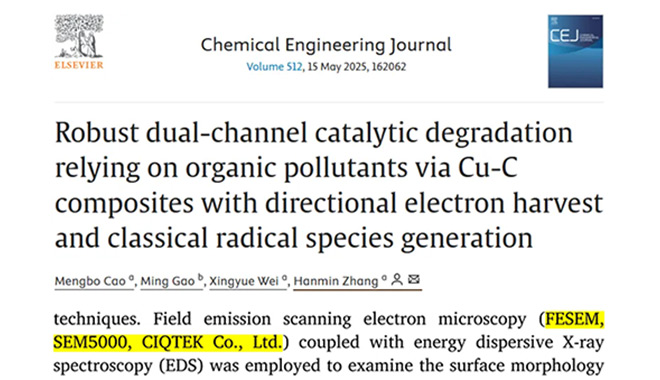
The study, entitled “Robust dual-channel catalytic degradation relying on organic pollutants via Cu-C composites with directional electron harvest and classical radical species generation”, was published in Chemical Engineering Journal.
Cu-C Nanocatalyst Formation
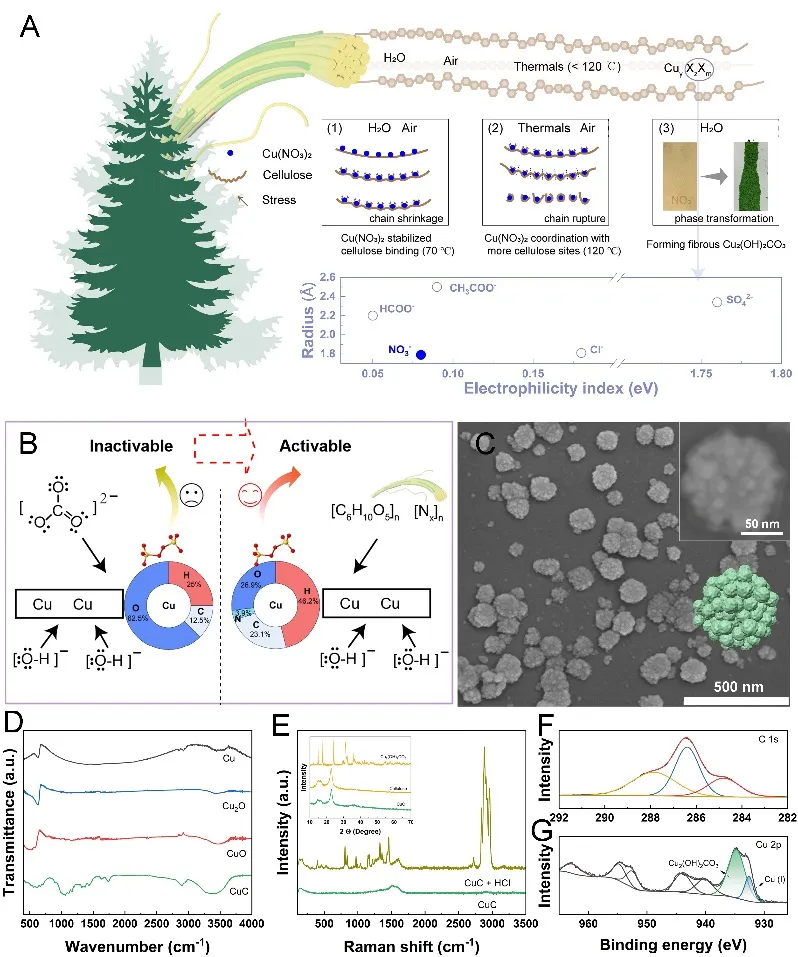
Using commercial cellulose as the support, the team incorporated copper ions via a wet-chemical galvanic replacement method to construct Cu-C nanocomposites with dual-channel catalytic activity. Characterizations revealed unique electron transfer effects under various conditions. SEM imaging (CIQTEK SEM5000) revealed the microstructural evolution: pristine cellulose exhibited a disordered network, which, after composite formation, transformed into 10 nm copper spheres that self-assembled into 100 nm hierarchical aggregates. This structure ensured high dispersion and electron transport. SEM-EDS confirmed uniform element distribution. FTIR spectra revealed a Cu₂O peak at 682.31 cm⁻¹ due to redox reactions during synthesis. The presence of C=C, C=O, and C–H groups further supported the findings, while a strong –OH peak was observed at 3200–3600 cm⁻¹. XPS analysis indicated that Cu 2p signals were primarily from Cu₂(OH)₂CO₃ and Cu₂O, with C 1s showing C=C and C–C bonds, consistent with FTIR results.
Figure 1. Preparation and Characterization of the Catalyst
Catalytic Degradation Performance
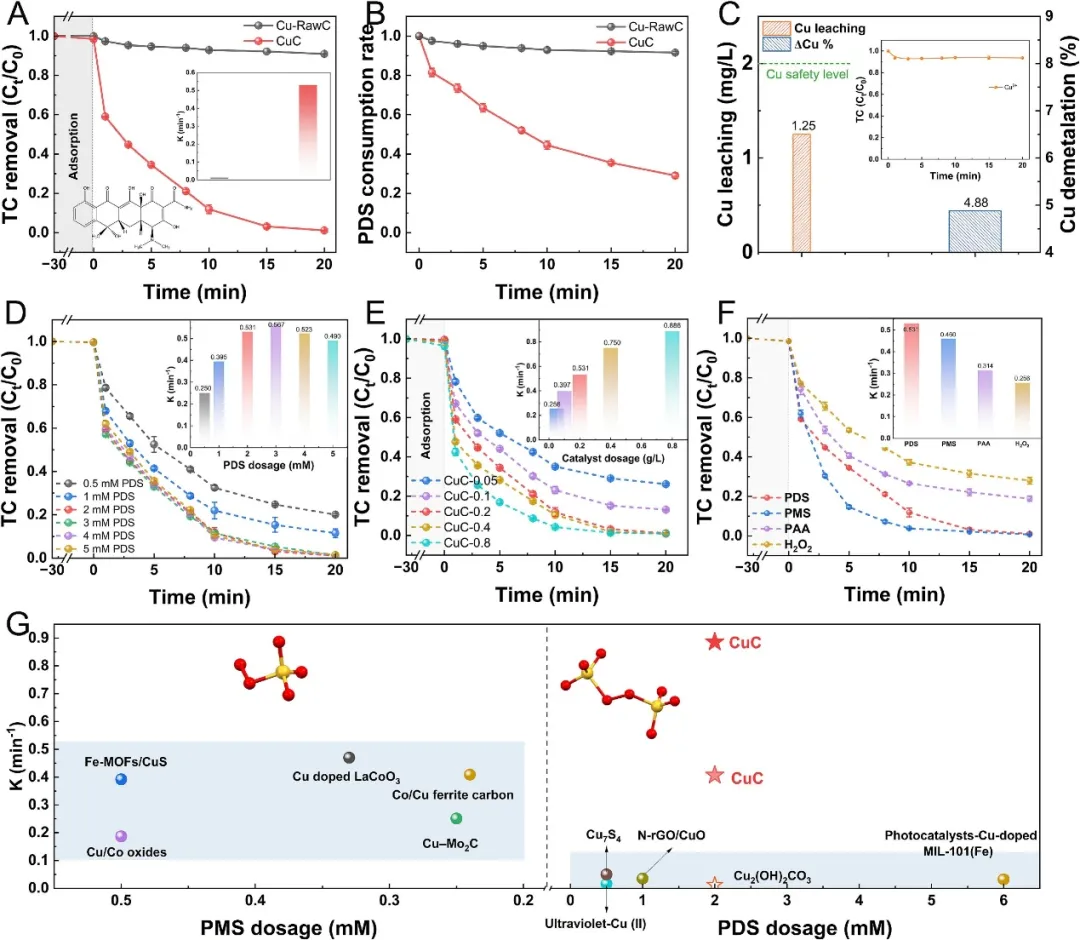
In persulfate (PDS) activation, the Cu-C catalyst exhibited dual degradation pathways: 65% tetracycline removal in 5 minutes (vs. <5% for commercial catalysts) with Cu leaching at only 1.25 mg/L, below the national limit. Control experiments confirmed that degradation originated from heterogeneous catalysis. Optimization studies on oxidant type, catalyst dosage, and oxidant dosage showed Cu-C’s superior performance compared to many copper-based catalysts.
Figure 2. Degradation Performance of Cu-C Nanocatalyst in Pollutant Removal
Dual-Channel Catalytic Pathways
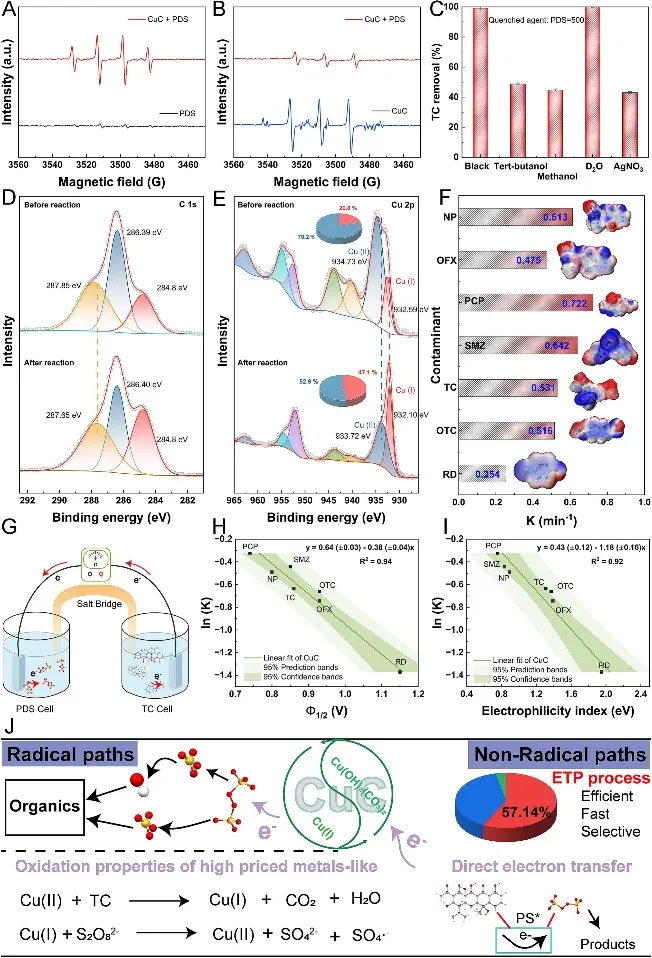
The synergistic mechanism involved both radical and direct electron transfer pathways, contributing ~55% and ~45% respectively. Radical quenching, EPR detection of SO₄•⁻ and •OH signals, XPS shifts (Cu(II) binding energy ↓1.01 eV), and electrochemical current measurements (~45 μA) all confirmed the coexistence of these mechanisms. The electron-donating ability of pollutants correlated positively with catalytic performance, further validating the direct electron transfer pathway.
Figure 3. Activation Mechanism Analysis with Dual-Channel Catalytic Pathway
Toxicity Reduction and Water Reuse
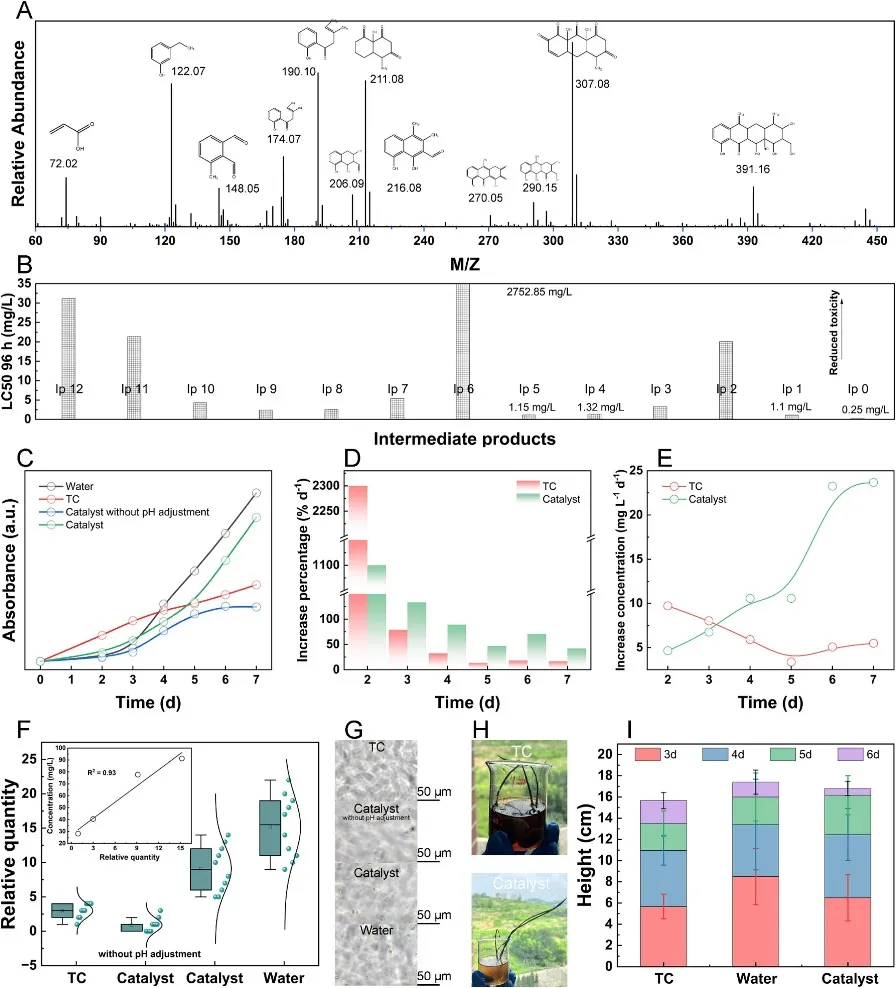
Toxicity analysis showed that intermediates had 96% lower LC₅₀ toxicity to fish compared to tetracycline, with 90% of intermediates exhibiting reduced developmental or mutagenic effects. Algal growth experiments demonstrated that treated water supported healthy algal biomass comparable to pure water. Lotus plants cultivated in treated water showed significantly better growth than those in untreated tetracycline wastewater, confirming the potential for safe water reuse.
Figure 4. Low Toxicity of Intermediates and Reuse of Treated Water in Aquatic Systems
Scalability and Adaptability
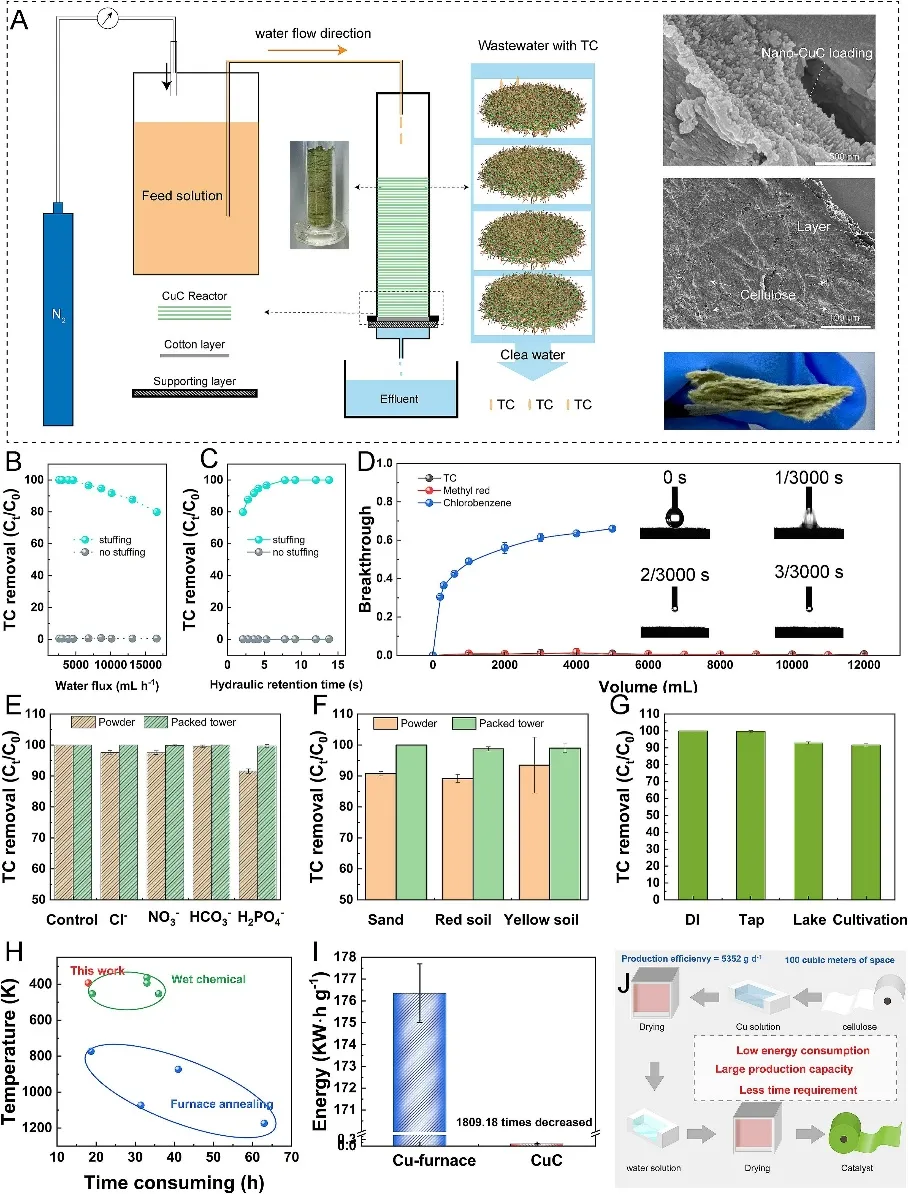
Practicality was validated using Cu-C powders and CuC@FC packed-bed reactors (PTRs). Continuous-flow experiments with tetracycline, methyl red, and chlorobenzene revealed >99% removal of electron-rich pollutants and dyes, though performance was lower for electron-deficient compounds. Compared with conventional high-temperature, high-pressure methods, Cu-C synthesis required significantly lower temperatures and shorter times, underscoring the feasibility of automated, large-scale, low-energy production for industrial applications.
Figure 5. Catalytic Adaptability and Large-Scale Production
This work achieves a dual breakthrough in both efficiency and sustainability for organic pollutant degradation. By enabling cooperative radical and direct electron transfer pathways, the Cu-C catalyst adapts to varying water conditions and pollutant characteristics. This design paves the way toward low-energy, highly compatible, and resource-oriented wastewater treatment, offering a new paradigm for industrial water remediation.
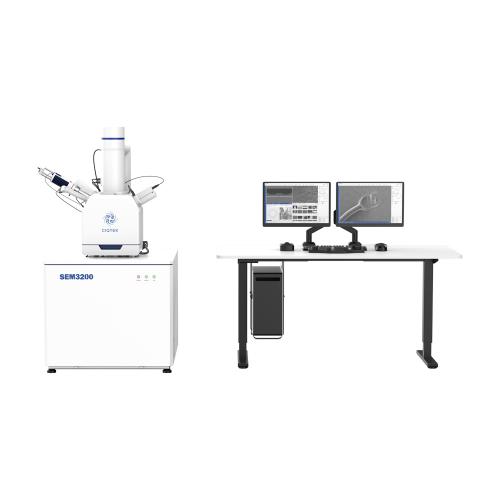
High-Performance and Universal Tungsten Filament SEM Microscope The CIQTEK SEM3200 SEM Microscope is an excellent general-purpose Tungsten Filament Scanning Electron Microscope (SEM) with outstanding overall capabilities. Its unique Dual-anode electron gun structure ensures high resolution and improves image signal-to-noise ratio at low excitation voltages. Furthermore, it offers a wide range of optional accessories, making the SEM3200 a versatile analytical instrument with excellent expandability.
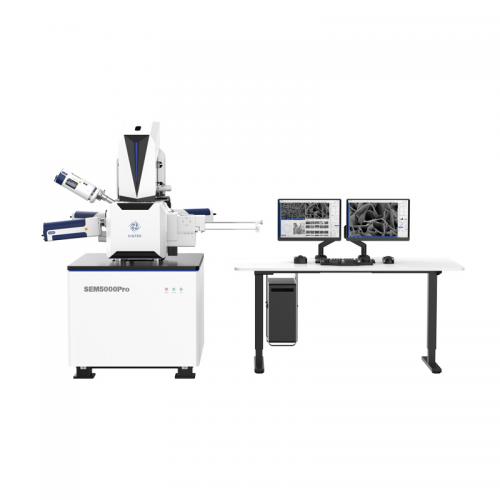
High Resolution under Low Excitation The CIQTEK SEM5000Pro is a high-resolution Schottky field-emission scanning electron microscope (FE-SEM) that specializes in high resolution, even under low excitation voltages. Employing an advanced "Super-Tunnel" electron optics technology facilitates a crossover-free beam path and an electrostatic-electromagnetic compound lens design. These advancements reduce the spatial charging effect, minimize lens aberrations, enhance imaging resolution at low voltages, and achieve a resolution of 1.1 nm at 1 kV, which allows for the direct observation of non-conductive or semi-conductive samples, effectively reducing sample irradiation damage.
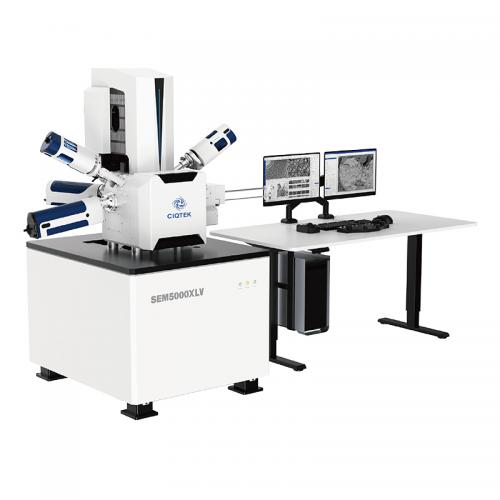
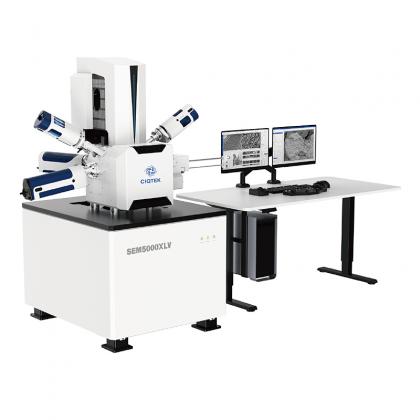
Ultra-High Resolution Field Emission Scanning Electron Microscopy (FESEM) The CIQTEK SEM5000X is an ultra-high resolution FESEM with optimized electron optics column design, reducing overall aberrations by 30%, achieving ultra-high resolution of 0.6 nm@15 kV and 1.0 nm@1 kV. Its high resolution and stability make it advantageous in advanced nano-structural materials research, as well as the development and manufacturing of high-technology node semiconductor IC chips.